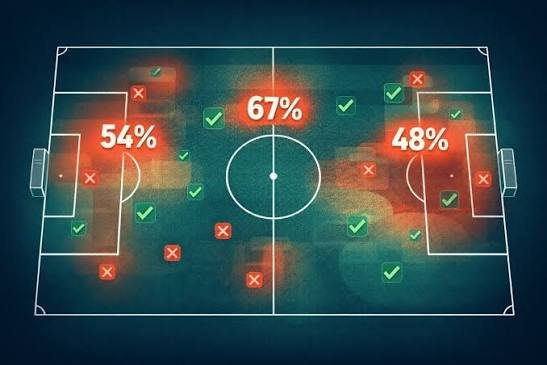
Association football has been so captivating for the longest time because of the romance that it has been able to showcase. A sense of wonder about it, gripes with how it evolved, and a constant search for understanding within the sport have governed much of its perception.

Beyond these issues that we have with refereeing, factionalism, commercialization and governance, among many other things, we are still trying to find a way to perceive and predict it. Now that AI technology has reached an advanced point of performance and customizability, things stand to see a great level of improvement.
However, thinking that even the best possible prediction model is perfect is a very arrogant presumption. Even the data-driven football predictions by BetBrain, backed by a lean and highly informed process, deliver below the 100% accuracy clip.
In this article, we will explore the genesis of this perception. We’ll talk about the nature of these simulations as a whole, what goes into their optimization, and why there are always factors that will lead to a slight failure in predicting the outcomes that end up happening.
By the time you finish reading, you’ll hopefully have a clear image of the dynamics that influence them.
Explaining the merit of football predictions in the modern world
So, why exactly would you even want to be able to generate or at least consult these predictions? What is it to gain from this way of interacting with the sport?
We believe there are multiple ways to answer these questions, and each of them presents a different perspective that can influence how you consider the entire process.
A better understanding of football
Your relationship with the sport used to grow as much as your passion for it has. The love for the game has been all about identifying the ebbs and flows of football, the driving factors behind success, and how talent, structure, and mentality lead to performance.
By turning them into metrics and points that can reveal their impact on results, it can be a way to bridge the gap between the eye test and the statistics that lead to the actual score and outcome.
As long as both the passion to watch the games and the data-driven perspective do not infringe upon each other, knowing where to look and how to identify patterns based on keen simulations can be really helpful and outright interesting.
Testing the accuracy of machine learning predictions
Some just want to know how much machine learning can grasp based on its accuracy rate. After all, it’s in our best interest to identify whether the tools that we use, the AI models in particular, are truly effective and worth the investments in their development.
Football games may not be the most groundbreaking human events, but they are good representations of human consistency that may or may not maintain their pacing. As such, relying on them as a vessel of analysis can be helpful in determining one of the ways of predictive prowess.
The inescapable betting usage
Yes, it’s everywhere. Sports betting has become so popular that finding a way to use predictions for wins is something that many have tried to harness. It’s not entirely unethical, but it’s far from a responsible choice given the fact that, as we’ll discuss, it’s impossible to have proper accuracy.
Instead, we need to remember that every predictive result that we get from them is a probability of that likelihood happening. If you bet on a team to win because it has 40% to do so, while the draw’s chances are 27%, and the other team to win has 33%, then you’re dealing with slim margins.
That’s why betting is a dangerous proposition when serving as the main motivation for using automated football predictions.
What helps a prediction model generate good results
This section will be relatively simple because we’ll showcase the crux of these factors, not go too much into detail.
It’s very important to note that these are just methods of stabilizing data into a readable model that can go through training. We know it when we see it on the pitch, but these are also coming from training methodologies that some cutting-edge football operations have been implementing for a while.
For us, the general public, it’s just what we see in real time while they play the actual games.
Properly arranged historical data
Historical data provides food for pattern recognition. All kinds of anomalies may have their respective genesis in factors that, at face value, do not necessarily appear recognizable. However, a highly intelligent model can correlate them, for better or for worse.
The idea is to see how each team interacts with its respective opponent, how it fares in that period of the season or competition, and why these factors may or may not lead to a stable influence on the final probabilities.
Current form signifiers
Current form is, generally, just a way for us to see if the team is doing fine or not. Its wins, draws, and losses tell us if they’re doing fine or not, the way they compete (losing or winning closely or dominantly), and how this can turn into a way to analyze them going forward.
Individual player performances, especially based on advanced football metrics and statistical output, are part of these perspectives as well.
Contextual factors
These can vary from the atmosphere perception of that specific stadium to the weather to everything else that you can see in a match. Even the decibel levels recorded in a certain arena can be influential factors, albeit on a significantly smaller scale.
As such, every piece of possibly modifying data must be part of the way a model understands how to analyze.
The types of variance that lead to unpredictable outcomes
Variance that has no particular source other than human unpredictability is the thing that not even an advanced AI model can understand…for now. Instead, it’s exactly what brings down the guarantee factor that many are searching for when relying on this type of assistance.
(Own) Goals caused by…luck
It’s simple: a shot, regardless of its xG value, can hit a body part of a defender, and there you have it: an own goal that has taken the goalie by surprise and has led to a really unexpected result.
This should tell us that not every particular chance’s quality is a given in the economy of the result. As such, there are clear factors that work against the discernible grain of data, and they are hard to fathom for any model that does not take too kindly to variance.
Emotional impulses causing bookings or eliminations
Sometimes, a player simply loses emotional control and decides to air out their frustration on a player from the other team. A blatantly intentional and brutal tackle, a slap, an elbow to their mouth, and so on. These are all decisions that are far from professional or logical, but they happen because the heat of the competition can take hold of them.
If it leads to a red card, either directly or via a second yellow, you have a new calculation that differs from the structure and formula that a model generated before kick-off. Human emotion is highly contextual, and the build-up to such factors does not work too clearly.
VAR interference
VAR is helpful in theory, but the way some referees have used it is inconsistent. The highly controversial disallowance of Egypt’s goal against Argentina in the 2026 World Cup Round of 16 match began with a (supposed) foul very early in the action, and the VAR intervention led to a change in game momentum.
The moral of the story is that another referee would’ve taken a different decision when consulting with VAR, which means that there is quite a lot of variance based on human interventions.
Conclusion: Responsibility is the most important
Now that you know that the pendulum is swinging in directions that are both discernible and not, you have better chances of grasping the true reality of football predictions: they are prone to inaccuracy because of the human factor.
As such, we’d like to remind you that responsible gambling is the only proper way of interacting with any betting activity, even if you feel confident enough to rely on these predictive models!
Leave a Reply